Adjusted Anion Gap Calculator and How to Interpret It
What the Anion Gap Assesses
The anion gap is a useful way to examine the balance of charged particles in the blood. It is derived from common electrolytes and helps clinicians judge acid-base balance, especially when reviewing metabolic acidosis. Although it is not a direct measurement of all acids in the body, it provides an important perspective into whether there are extra unmeasured anions affecting blood chemistry.
In basic terms, the anion gap compares the positively charged ions, mainly sodium, against the negatively charged ions, mainly chloride and bicarbonate. If the gap is higher than expected, it can suggest that acid is accumulating in a way that is not fully reflected by the standard electrolyte panel. That makes it an important screening and interpretive tool in many forms of acid-base disorder.
Because the anion gap is calculated from routine lab values, it is often used as a diagnostic tool rather than a standalone diagnosis. It can support acid-base analysis and help narrow the causes of metabolic acidemia, but the number must always be read in context with the patient’s symptoms, the serum electrolytes, and the rest of the blood chemistry.
How the Anion Gap Calculator Operates
An Anion Gap Calculator uses lab values for sodium, chloride, and bicarbonate to calculate the gap between measured cations and anions. The standard calculation is simple: sodium minus chloride minus bicarbonate. Some formulas also include potassium, but the sodium-based version is the most frequently used in day-to-day clinical practice.
This calculation method is designed to be rapid and repeatable. By entering the lab values into the calculator, you get an prompt result that can support clinical interpretation. Because the result depends on the lab measurement of these electrolytes, even small shifts in sodium, chloride, or bicarbonate can change the final number.
The calculator is especially helpful when reviewing an electrolyte panel alongside symptoms of possible acidosis, dehydration, intoxication, or kidney dysfunction. In other words, the calculator does not take the place of judgment; it organizes data into a form that makes electrolyte imbalance easier to spot.
Corrected Anion Gap Formula
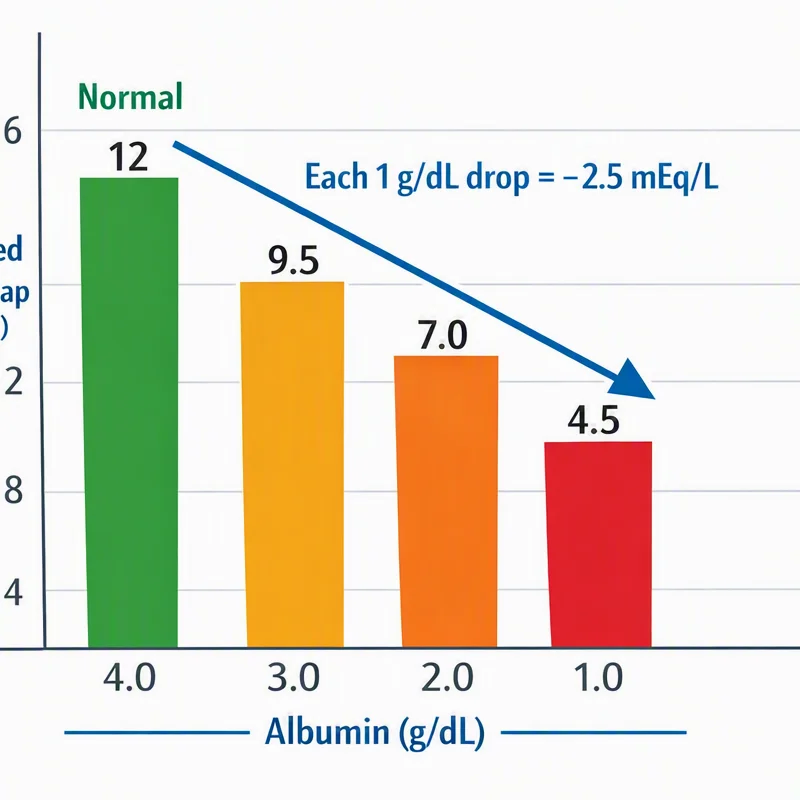
The adjusted anion gap modifies the raw value for albumin, which is the most important unmeasured negatively charged protein in blood. Because albumin changes the baseline gap, a low serum albumin level can cause the uncorrected result look falsely normal. For this reason an albumin correction is often used when interpreting the result.
A commonly used equation is:
Adjusted anion gap = Raw anion gap + 2.5 × (4.0 - serum albumin in g/dL)
This adjusted formula assumes a reference albumin of about 4.0 g/dL. If albumin is lower than that, the correction increases the gap. The logic is simple: less albumin means fewer negatively charged proteins contributing to the normal baseline, so the measured value may miss the true gap.
Different laboratories or reference texts may use slightly different correction factors. For that reason the calculator should be viewed as a reference that supports interpretive guidance, not an absolute truth. Even with variation, the central idea remains the same: account for albumin before concluding that the anion gap is normal.
Reasons why Serum albumin Changes the Outcome
Hypoalbuminemia remains one of the most frequent reasons the anion gap requires recalculation. Albumin in the blood possesses a negative charge, so it adds significantly to the group of serum proteins that shape the normal gap. When albumin falls, the anticipated gap falls too, and the reported value can be deceptive if it is not adjusted.
This occurs because of protein charge. Albumin serves as a major unmeasured anion in the blood. If the concentration decreases, there are reduced numbers of negatively charged particles present, so other acid-related changes may be hidden. In practical lab interpretation, this means a patient may have clinically significant acidosis even when the uncorrected number does not look strikingly high.
Correcting for albumin is especially important when reading results in patients with chronic illness, inflammation, poor nutrition, liver disease, or critical illness. In those settings, the raw number may underestimate the burden of acid retention and minimize the severity of the acid-base balance problem.
Step by step Example Calculation
This is a straightforward illustrative calculation to illustrate how the correction changes the result.
Consider the lab values are:
- Na: 138 mmol/L
- Cloride: 102 mmol/L
- Bicarbonate: 22 mmol/L
- Albumin: 2.5 g/dL
First, calculate the raw anion gap:
138 - 102 - 22 = 14
Then apply the albumin compensation:
Adjusted value = 14 + 2.5 × (4.0 - 2.5)
Final value = 14 + 2.5 × 1.5 = 14 + 3.75 = 17.75
The corrected result is greater than the measured one. That difference may influence the clinical interpretation, especially if the patient appears to have acidosis or another acid-base imbalance. What looked slightly abnormal could actually represent a more significant gap once albumin is accounted for.
This example shows why the Anion Gap Calculator is more useful when it includes albumin correction. Without that step, a clinician might fail to detect a clinically important abnormality or downplay the degree of acid accumulation.
Typical Range plus Unusual Results
The reference range for the anion gap depends on the lab method and whether potassium is included. Owing to these differences, the most important step is to use the local normal interval listed with the lab report. In many settings, a “normal” gap may fall roughly in the low teens, but the exact cutoff should come from the lab values themselves.
A normal anion gap does not always mean normal physiology. A patient with low albumin can have a deceptively normal number even while another acid-base problem is present. In contrast, a elevated anion gap often points toward added acids or retained unmeasured anions and should prompt a search for the underlying cause.
A reduced anion gap is less common but can still be clinically meaningful. It may reflect hypoalbuminemia, excess positively charged proteins, or technical issues in the lab process. Any result outside the expected range should be reviewed together with the electrolyte panel and the patient’s overall condition.
Typical Causes of an Elevated Anion Gap
An elevated gap Additional reading usually suggests extra acids are present or that the body is holding onto acids it cannot clear efficiently. Several common causes should be considered during acid-base analysis.
- Lactic acidosis, often linked to hypoperfusion, sepsis, severe illness, or tissue hypoxia
- Ketoacidosis, including insulin-deficiency, alcoholic, or starvation-related states
- Renal failure, where acid excretion is decreased and unmeasured anions may rise
- Toxic alcohols, such as methanol or ethylene glycol, which can cause dangerous high-gap acidosis
These conditions are frequent causes of metabolic acidosis with a high anion gap. However, the exact diagnosis depends on the overall clinical picture, not the gap alone. For example, a patient with severe vomiting, altered mental status, or shock may require a different workup depending on the accompanying blood chemistry and history.
The gap is best used as a clue that points to the next step in evaluation. It may help with targeted testing for lactate, ketones, kidney function, toxic exposures, or other causes of acid accumulation.
Typical Reasons of a Typical or Decreased Anion Gap
A normal anion gap is often seen with hyperchloremic acidosis, where bicarbonate decreases and chloride rises in a counteracting pattern that keeps the computed gap from increasing. This can happen in loose stools, certain tubular kidney disorders, or after certain infusions and medicines.
A reduced anion gap may be seen with low albumin, which is one of the most frequent explanations. Because albumin contributes a negative protein charge, a decrease in albumin lowers the anticipated gap and can hide a problem if the result is not adjusted.
Other causes include myeloma, where abnormal proteins disrupt the charge balance, and lab error, which must always be considered. A low value can result from specimen issues, contamination, analyzer problems, or plain calculation errors. For that reason, unexpected results should never be taken at face value without review.
In short, a normal or low number does not automatically rule out illness. The key is whether the value fits the rest of the patient’s acid-base picture and whether the lab context backs up the result.
Key Applications for the Calculator
The Anion Gap Calculator is especially helpful in ICU settings, where rapid acid-base assessment can inform prompt care decisions. In intensive settings, patients may have mixed disorders, shifting albumin levels, and rapidly changing electrolyte values, so a corrected estimate can improve clinical interpretation.
It is also valuable in emergency care, where clinicians need a fast way to triage acid-base acidosis and determine whether a patient may have a toxin exposure, ketoacidosis, sepsis-related lactate elevation, or other urgent issue. The calculator can serve as a quick screening step before deeper workup.
In kidney disease, the calculator can track acid retention and determine whether abnormal blood chemistry reflects worsening excretion or another cause. It is also helpful in broader acid-base disorders, including mixed states where bicarbonate may be altered by more than one process.
When used properly, the calculator is not just a number generator. It is part of a systematic evaluation of the patient’s chemistry, serum electrolytes, and overall physiologic state.
Limitations and When to Recheck Labs
Even a well-designed calculator has limitations. Small measurement error in sodium, chloride, bicarbonate, or albumin can meaningfully change the result. This is why an unexpected number should be compared against the overall electrolyte panel and the clinical scenario rather than interpreted in isolation.
If the result is inconsistent with symptoms, acid-base status, or other blood tests, repeat testing may be warranted. This is especially true when there is concern for specimen mix-up, analyzer inconsistency, or a sudden change that does not fit the patient’s condition. A single odd result should not supersede the rest of the data.
Special attention should be paid to serum bicarbonate, since it is central to the calculation and to broader acid-base interpretation. If bicarbonate is unexpectedly low or the panel appears internally inconsistent, the numbers may need to be verified. A second sample can help determine whether the first value was affected by lab error or another preanalytic issue.
In practice, the best use of the calculator is to support systematic review: verify the panel, consider albumin correction, and recheck when the data do not make physiologic sense.
Frequently Asked Questions
What is the corrected anion gap formula?
The corrected formula amends the measured anion gap for low albumin. A common version is: corrected anion gap = measured anion gap + 2.5 × (4.0 - serum albumin in g/dL). This anion gap formula helps account for the effect of albumin on the expected baseline.
Why adjust the anion gap for albumin?
You adjust for albumin because albumin is a major negatively charged protein in blood. When serum albumin is low, the uncorrected value may underestimate the true gap. The albumin adjustment strengthens interpretation and makes the result more useful for clinical interpretation.
What does a high anion gap mean?
A high anion gap often indicates the presence of extra acids or retained unmeasured anions. Common causes include lactic acidosis, ketoacidosis, renal failure, and toxic alcohols. It is a clue that should trigger further evaluation rather than a final diagnosis by itself.
Can a normal anion gap still be abnormal?
Yes. A normal anion gap can still be abnormal if the patient has hypoalbuminemia or another condition that masks the true acid-base picture. Some forms of hyperchloremic acidosis also present with a normal gap, so a normal result does not always mean normal physiology.
When should the anion gap be rechecked or repeated?
Recheck or redo the lab when the result does not fit the clinical picture, when there is concern for measurement error or lab error, or when the electrolyte panel seems inconsistent. Repeat testing is also useful if sodium, chloride, bicarbonate, or albumin may have changed quickly.
Used thoughtfully, the Anion Gap Calculator is more than a quick arithmetic tool. It helps clinicians move from raw blood chemistry to meaningful acid-base analysis, especially when albumin correction is included. By considering the corrected result, the reference range, and the broader clinical context, users can make safer and more accurate decisions about metabolic acidosis and related disorders.